What I Wish I Could Have Taught My Dad
Today is World Suicide Prevention Day. This is the most personal thing I’ve ever written, and the most important thing I’ve ever built.
Today is World Suicide Prevention Day. This is the most personal thing I’ve ever written, and the most important thing I’ve ever built.
If you are in immediate danger, please stop reading and call your local emergency number (988 in the US), or find crisis lines for your country at theshinehopecompany.com/get-support. If you are actively struggling, please reach out to someone today: a professional, a crisis line, a person you trust. What follows is not a crisis service, and it is not a replacement for that support. It is meant to sit alongside the work you do with professionals.
First, I want to be clear: I’m not a doctor, and this is not medical advice. I’m someone who has lived it, from both sides. I lost my dad to suicide, and I nearly died by suicide myself. I still have suicidal thoughts today. I’ve just learned a different way to manage them.
I want to start with a question.
What if there’s a missing link in suicide prevention?
Most of what we hear about is the moments after: the hotline, the hospital, the safety plan, the restriction of means. All of that matters. I’ve needed some of it myself.
But what about the moment before?
The moment when emotional despair collides with motivational helplessness. When the thinking brain goes offline. When logic disappears, thoughts feel absolute, and “just reach out” becomes the one thing you cannot do.
Nobody taught me what that moment was. And nobody taught me how to manage it.
What if we changed that?
What if we deconstructed that moment, and taught the world how to move through it?
And what if we learned it from someone who has lived it, and who spent years studying with leading doctors, researchers, advocates, and the brave people with lived experience who share their stories?
That’s what I set out to do. Not as a replacement for anything, but as a different way. Here’s why.
Why I built it
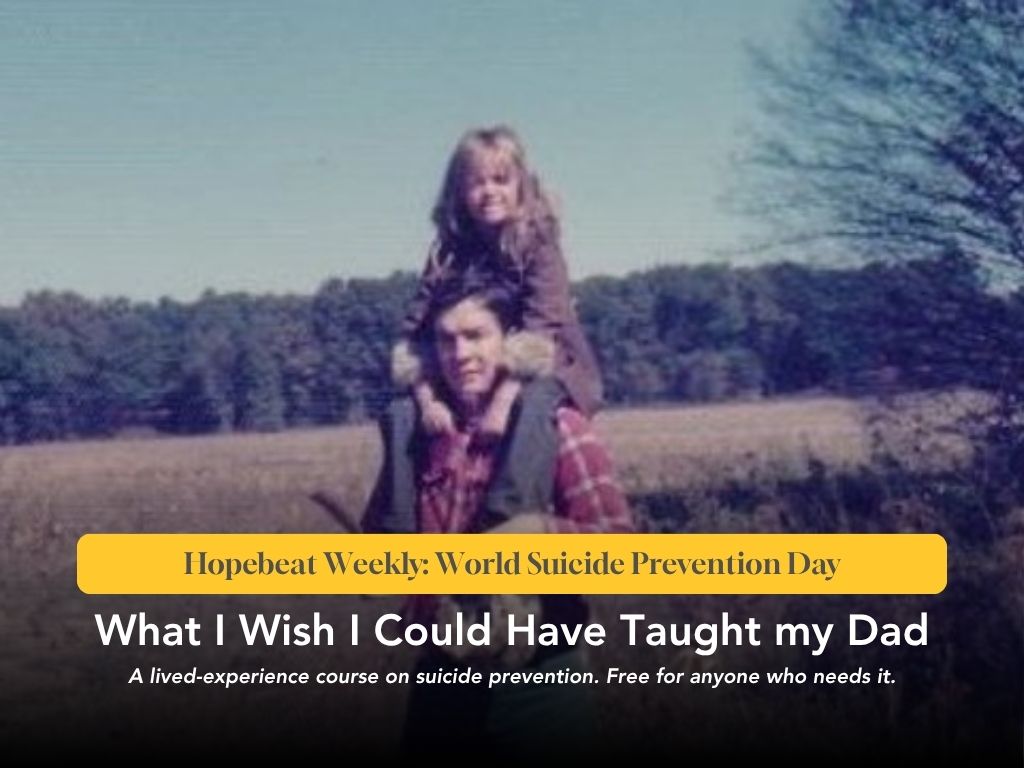
I built this course because it is what I wish I could have taught my dad before he died by suicide.
And it is what I wish I had known before I nearly did.
Doctors have told me I am at high risk for suicide. I carry nearly every known risk factor. When I asked what to do about it, the answer was: restrict your access to means, and call a hotline.
I knew that wouldn’t be enough for me.
Not because those things don’t matter. They do. But they are external. They’re about what’s around you. They never explained what was happening inside my brain when the thoughts showed up, or what I could actually do in that moment, alone, at 2 a.m., when calling anyone felt impossible.
So I spent the last fifteen years figuring it out, in a way that made sense to me.
I studied Hope Science, neuroscience, and global mental health research. I learned from clinicians and researchers, from advocates, and from people with lived experience who were brave enough to tell the truth about what those moments feel like. I tested what I learned in my own real moments of despair. I kept what worked and threw out what didn’t.
What came out of it is a system. I still use it today to manage my own suicidal ideation.
That system is now a self-guided, skills-based course: From Hopelessness to Hope: A Lived-Experience Perspective on Suicide Prevention.
What I share
A new way of seeing suicidal thoughts. Why I’ve come to see them not as a desire to die. Why thinking narrows and logic disappears. Why the thoughts feel so urgent and so convincing.
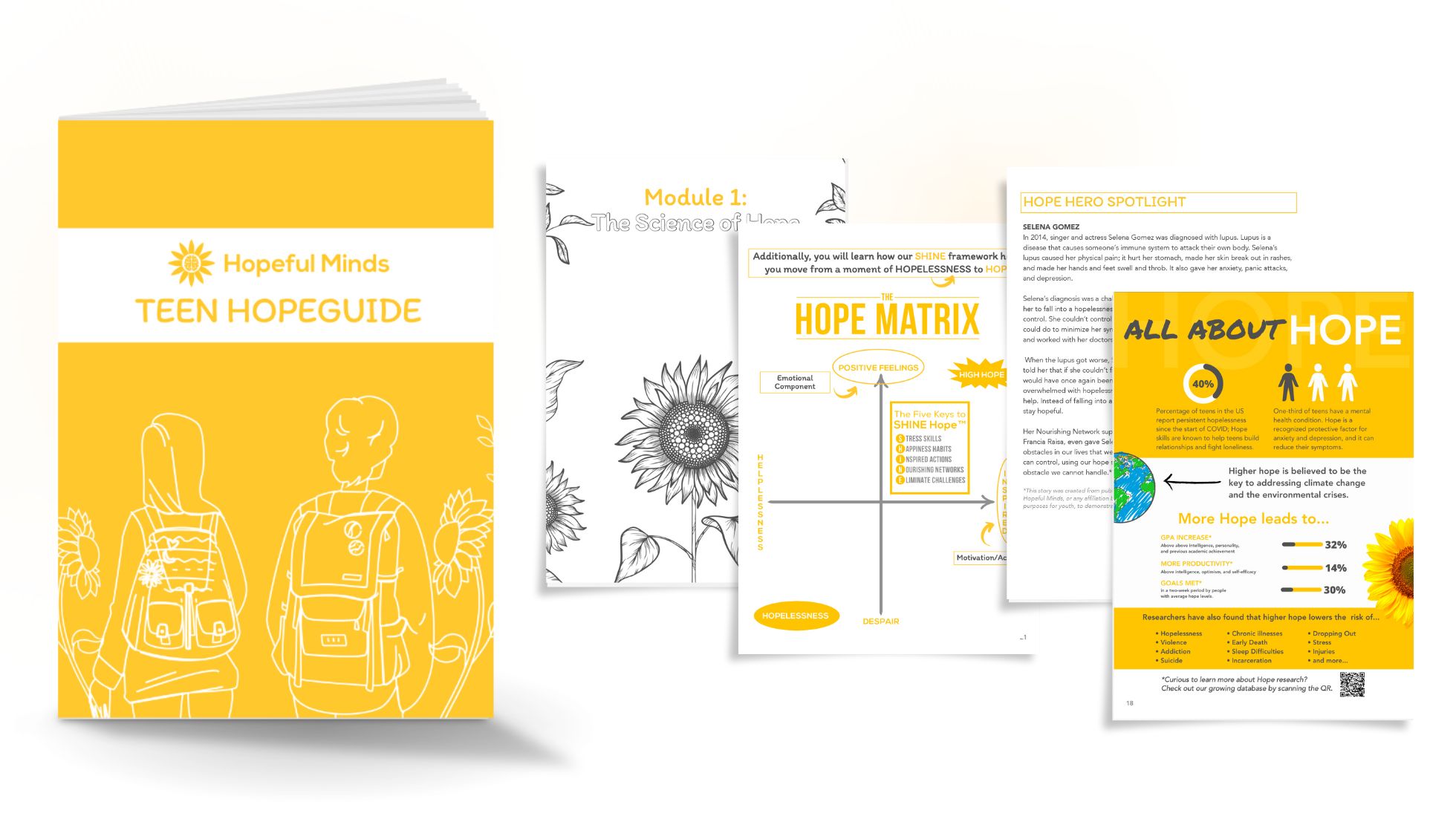
The Hope Matrix. A simple visual model showing how despair combined with helplessness creates hopelessness, one of the most consistent predictors of suicide across populations. Once I could see it, I could start to interrupt it.
The biology of the moment. What a “brain attack” is. Why it feels impossible to think clearly. Why it feels impossible to reach out. What is actually happening in your nervous system.
The Prefrontal Brain Reset. A 90-second protocol I use to help my thinking brain come back online in acute moments.
The Shine Hope® Framework. Five skills I use to interrupt hopelessness in the moment: Stress Skills, Happiness Habits, Inspired Actions, Nourishing Networks, and Eliminating Challenges.
Supporting someone you love. What helped me, what didn’t, and new ways to look at it.
A Commitment to Life Plan. How I built mine, on strengths, values, and the future.
It comes with a video course narrated by me, a full downloadable workbook, and lifetime access including every future update.
Who this is for
If you experience suicidal thoughts, this is for you.
If you love someone who does, and you lie awake not knowing what to say, this is for you.
If you’re a parent, partner, sibling, teacher, clinician, or helper, this is for you.
And if you’re none of those, it’s still for you. Because every human being experiences moments of hopelessness. The only question is whether you have the skills when it comes.
It is not therapy, not medical advice, and not the single answer. It’s additional ideas and new perspectives, from someone who has lived it and found that the answers I was given didn’t work for me. It’s meant to sit alongside the work you do with professionals, not replace it.
What I’m asking you to do today
Take the course for $49, for yourself or for a new way of looking at what someone you love may be going through.
Or choose $69, and your extra seat goes to someone who can’t afford it.
If cost is a barrier for you, use code SHINETOGETHER at checkout. Free through September 30, no questions asked.
A final word
Today, we honor everyone we’ve lost to suicide. I honor my dad.
And we stand with everyone who is struggling right now, everywhere, whether anyone knows it or not. We see you. We are here.
I cannot promise that life will always feel manageable. I can’t promise that for myself.
But I know from experience that skills can change outcomes. They changed mine. And the more it rains, the more I need to Shine.
Get curious with me. Let’s change the way the world approaches this.
Keep Shining Hope,
Kathryn
Kathryn Goetzke, MBA
CEO & Chief Hope Officer, The Shine Hope Company
Author of The Biggest Little Book About Hope
Founder of International Foundation for Research and Education on Hope (iFred)
Creator of Hopeful Cities, and Hopeful Minds
Creator of Hopeful Mindsets Overview, Hopeful Mindsets in the Workplace Overview, and Hopeful Mindsets on the College Campus Course
Podcast host of The Hope Matrix
Chief Mood Officer, The Mood Factory (taking a break, for hope!)